Canada’s Rental Housing Pivot: CMHC’s $55-Billion Plan—and the Homeownership Question
Canada is committing substantial public financing to rental housing. But when the government announces “new homes,” Canadians should ask a second question: homes to rent, or homes they can eventually own?
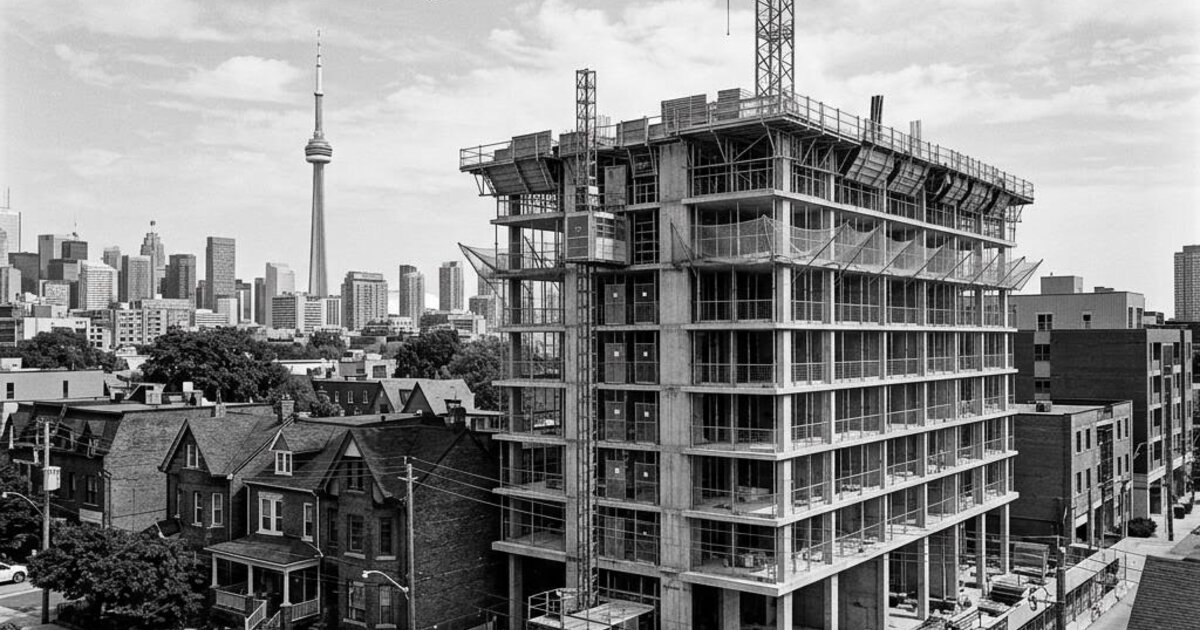
A November 20, 2026 announcement from Canada Mortgage and Housing Corporation provides a useful starting point. Federal and municipal support will help build 92 affordable homes at Green Phoenix II, 1337 King Street West in Toronto. It is a concrete housing project with a social purpose. It also illustrates a broader emphasis on rental construction and preservation that deserves close examination.
There is an important correction to make before examining that policy: this particular announcement is not Ottawa buying existing houses. It concerns construction funding. A separate federal acquisition fund does help community housing providers buy existing rental properties. Mixing those activities together hides what the money is actually doing.
By Sarah Antonia Colucci, Mortgage Agent Level 2 | The Mortgage Shrink | Sherwood Mortgage Group, Broker Lic. #12176. Published and fact-checked November 22, 2026.
The short answer: how much has CMHC allocated to purpose-built rentals?
The most direct national figure is the Apartment Construction Loan Program, or ACLP. The government’s June 2026 National Housing Strategy progress report lists $54.9 billion in announced funding over 15 years, from 2017–18 through 2031–32. CMHC rounds that to $55 billion in its October 16, 2026 Toronto release.
As of June 30, 2026, the progress report records $32 billion in committed ACLP loans supporting 81,918 rental units. Of those units, 26,083 were built and 31,846 were under construction; the remaining units were at conditional or financial commitment stages.
Those are dated reporting figures, not a claim about the exact balance on November 22. They also do not mean $55 billion has already been spent or that 81,918 homes have all been completed. The distinction between a program envelope, a loan commitment, cash advanced and a finished apartment is essential.
Source: National Housing Strategy progress report, reporting to June 30, 2026; CMHC’s October 16, 2026 announcement.
What is being funded at Green Phoenix II in Toronto?
The November 20 release describes a 10-storey, 92-unit development at 1337 King Street West, delivered with the Parkdale United Church Foundation. The Foundation describes the project as entirely deeply affordable housing.
CMHC’s funding breakdown lists:
- $29 million in federal Affordable Housing Fund support.
- $77,200 in CMHC Seed Funding.
- $15.5 million in City of Toronto capital funding under its Rental Housing Supply Program.
- More than $2 million in property-tax exemptions to support long-term affordability.
- $300,000 from the Parkdale United Church Foundation.
The release does not provide a project-specific split of the $29 million between repayable financing, forgivable financing and contributions. It would therefore be inaccurate to call the entire amount either a non-repayable grant or a conventional loan.
Nor should tax exemptions be described as cash handed over at construction. They are a different form of assistance. These figures are reported components of support, not a verified all-in construction budget or purchase price.
This project is funded through the Affordable Housing Fund, not the ACLP. It should not be presented as another $29 million on top of the national ACLP envelope. Read the original CMHC announcement.
Construction, acquisition and conversion are different policies
1. Financing new purpose-built rental housing
Purpose-built rental generally means homes developed to be rented rather than individually sold to end buyers. CMHC says ACLP provides low-cost financing from construction through stabilized operations, with eligibility and underwriting requirements.
CMHC describes these as fully repayable, low-interest loans. Public financing is consequential, but its face value is not the same thing as a non-repayable expenditure. Loan repayment, financing terms and credit risk matter when assessing the public cost.
2. Helping providers purchase existing rental buildings
The separate $1.5-billion Canada Rental Protection Fund supports acquisitions and renewals of existing affordable rentals. A federal release dated September 22, 2026, and modified September 23, says the Canadian Housing Acquisition Fund was selected to deploy the investment, with oversight from Build Canada Homes.
The model helps community housing providers acquire and preserve at-risk rental properties. That is not the same as CMHC buying detached homes directly for the federal government, nor is it evidence that Ottawa is purchasing every unsold condominium.
The release says the fund has the potential to protect 7,000 at-risk rental homes in its first five years, subject to market conditions and acquisition opportunities. That is an expected potential outcome, not a completed acquisition count. Source: Canada Rental Protection Fund launch announcement.
3. Converting buildings into rental housing
Conversion is another route. CMHC’s ACLP page says the program has options to build rental housing or convert non-residential buildings into rental housing. A conversion can add rental supply, but it is not automatically a purchase of existing owner-occupied homes.
For each announcement, ask: who owns the property, what is being built or acquired, what tenure will the homes have, and which public program is involved?
The national funding figures—without double-counting
- ACLP: $54.9 billion announced, commonly rounded to $55 billion. A multi-year construction-loan envelope; $32 billion committed as of June 30, 2026.
- Affordable Housing Fund: $15.83 billion committed as of June 30, 2026. The progress report divides this into $9.75 billion in loans and $6.08 billion in contributions or forgivable loans. It covers both new housing and repairs—not just new purpose-built apartments.
- Canada Rental Protection Fund: $1.5 billion in federal investment. A separate acquisition-and-preservation initiative overseen by Build Canada Homes, not a CMHC construction-loan subtotal.
The November 20 CMHC release describes the Affordable Housing Fund as a $16.1-billion program and says its application portal is closed because all funding has been committed. The dated June report provides the commitment breakdown above. Different reporting dates and program measures should not be silently treated as interchangeable.
Do not add these numbers into a single “CMHC spent this much buying homes” headline. They mix envelopes, commitments, loans, contributions, construction, repairs and acquisition support. Local announcements can also describe projects already financed within a national program rather than new money on top of it.
The sources reviewed do not establish a single, current amount of cash disbursed exclusively to all purpose-built rental projects as of publication. This article therefore reports the available dated figures rather than substituting commitments for disbursements.
Toronto’s larger rental partnership shows the policy emphasis
The federal government’s August 5, 2026 Toronto partnership backgrounder describes 18 projects expected to deliver more than 5,600 rental homes, through both Build Canada Homes and CMHC’s ACLP.
Its breakdown includes more than $1.8 billion in ACLP low-cost financing for nine projects and up to $600 million in additional ACLP capacity for future eligible Toronto projects. Separately, it lists more than $310 million through Build Canada Homes for nine projects on City-owned land.
The backgrounder identifies 3,720 units in the ACLP portfolio, including 1,079 affordable units. That alone demonstrates why “rental” and “affordable” cannot automatically be used as synonyms.
The financing remains subject to underwriting, credit approval, program requirements and loan agreements. An expected construction start is not proof that a project has started or that residents have moved in. Source: August 5 federal partnership backgrounder.
Why is the government emphasizing rentals?
The official rationale is to increase supply, preserve existing affordability and serve households whose needs are not being met by the market. The Green Phoenix II release explicitly connects housing with help and health, including supports for people facing homelessness.
CMHC also identifies construction through stabilized operations as the riskiest phase of development—the period ACLP financing is intended to support. Funding a viable building can be more directly targeted than assuming every approved project will obtain private financing on workable terms.
There is a legitimate case for stable rental housing. Not every household is ready to buy, and some do not want to. A housing system needs options for renters as well as owners. Preserving an occupied affordable building also serves a different purpose from adding new units: it can protect existing residents, but acquisition alone does not create additional homes.
Calling this a rental-focused policy emphasis is supported by the programs examined here. Claiming that government has abolished homeownership as a goal, or that this one announcement proves a plan to make everyone rent, would go beyond the evidence.
The homeownership question still needs an answer
Helping someone secure a rental home is not the same as helping them acquire an ownership interest in a home. Both can be worthwhile goals, but they produce different outcomes.
A renter may gain stability and an affordable payment. An owner takes on mortgage obligations, maintenance costs and property-market risk, alongside the possibility of building equity. Neither outcome should be reduced to a slogan.
My concern is about how success is measured. If public announcements emphasize a growing number of “homes” without making tenure clear, a would-be buyer may reasonably think the policy is expanding ownership opportunities when the units are intended to remain rentals.
For aspiring buyers in Toronto, Newmarket, Aurora and across Ontario, the question is: alongside rental supply, what is improving the practical route to a down payment and a sustainable purchase? These rental announcements do not, on their own, answer that question.
That is a policy critique—not an argument against housing people who need affordable rentals, and not proof that rental financing is directly taking a home away from a particular buyer.
What taxpayers and residents should ask next
- How many homes are complete and occupied? Separate announcements, conditional commitments, construction and delivery.
- Who owns the finished building? Public funding does not necessarily mean direct government ownership.
- What does affordable mean here? Ask about actual rents, eligible household incomes, the share of units covered and the duration of restrictions.
- What is repayable? Separate conventional loans, forgivable loans, contributions and tax assistance.
- Are these new homes or preserved homes? Both matter, but they should be counted separately.
- What is improving access to ownership? Rental delivery should not be used as a substitute measure for homebuyer outcomes.
What does this mean for your mortgage decision?
A federal housing allocation is not a personal mortgage approval and does not guarantee lower interest rates or a cheaper home. Buyers should work from their own income, debts, down payment and realistic ownership expenses—not an assumption that a government announcement will change their numbers.
Homeowners approaching renewal should similarly compare actual offers and contract terms. A public construction loan for an apartment developer is not the same product as a mortgage offered to an individual household.
You can explore a preliminary mortgage match, review the live bond yields and rates dashboard, or call Sarah at 647-773-4849 to discuss your circumstances. Recommendations remain subject to lender criteria and verification.
For the separate issue of banking competition, read our analysis of OSFI’s proposed capital changes for smaller banks. That proposal should not be confused with CMHC’s rental-construction programs.
Frequently asked questions
How much has CMHC allocated to purpose-built rental construction?
The June 2026 National Housing Strategy report lists $54.9 billion in announced Apartment Construction Loan Program funding through 2031–32, rounded to $55 billion in CMHC releases. It reports $32 billion in loan commitments as of June 30, 2026. The program envelope is not the amount already disbursed.
Is the government buying houses through the Green Phoenix II announcement?
The November 20, 2026 announcement describes funding to build 92 affordable homes at 1337 King Street West in Toronto. It does not describe Ottawa buying existing houses or purchasing condominium inventory.
Is Apartment Construction Loan Program financing a grant?
No. CMHC describes ACLP financing as fully repayable, low-interest loans. Other programs, including the Affordable Housing Fund, can use different combinations of loans, forgivable loans and contributions.
What is the $1.5-billion Canada Rental Protection Fund?
It is a separate federal initiative overseen by Build Canada Homes. The Canadian Housing Acquisition Fund was selected to deploy the investment to help community housing providers acquire and renew existing affordable rentals. It is not an additional CMHC apartment-construction loan allocation.
Does purpose-built rental mean every apartment is deeply affordable?
No. Purpose-built rental describes housing developed for renting rather than individual sale. Affordability rules depend on the program and project. Green Phoenix II is described as deeply affordable; the wider rental-construction portfolio should not automatically be given the same label.
Does more rental funding mean the government has ended homeownership support?
These announcements show substantial support for rental construction and preservation, but do not establish that all homeownership support has ended. Whether policy provides an adequate route to ownership is a separate question requiring scrutiny.
Sources and reporting dates
- CMHC: Canada announces the funding of new homes in Toronto, November 20, 2026. Green Phoenix II project, funding components and Affordable Housing Fund status.
- Housing, Infrastructure and Communities Canada: National Housing Strategy progress—June 2026, reporting to June 30, 2026. National program envelopes, loan commitments, affordability counts and construction stages.
- CMHC: Groundbreaking of new homes in Toronto, October 16, 2026. Rounded $55-billion ACLP envelope, repayable-loan description and June commitment figures.
- CMHC: Apartment Construction Loan Program, live program page accessed November 22, 2026. Construction-to-operations financing and non-residential conversion options.
- Federal backgrounder: Canada and Toronto rental-housing partnership, August 5, 2026. Portfolio, financing capacity, affordability counts and conditions.
- Build Canada Homes: Canada Rental Protection Fund launch, release dated September 22, 2026; page modified September 23, 2026. Acquisition fund, administrator, oversight and conditional preservation objective.
Fact-checked November 22, 2026. All dollar figures are Canadian. Funding totals have different scopes and reporting dates; they are not additive. The article distinguishes announced capacity, commitments, disbursements and completed homes. Commentary on homeownership is analysis, not an assertion of an undisclosed government motive. General information only; not a mortgage commitment or individualized financial advice.