Bank of Canada October 28 Rate Hike Risk: Why 2027 Could Bring Higher Rates
Fact-checked October 21, 2026. By Sarah Antonia Colucci, Mortgage Agent Level 2 | The Mortgage Shrink | Sherwood Mortgage Group, Broker Lic. #12176.
The risk of a Bank of Canada interest-rate hike on October 28 has increased, and some forecasters anticipate further increases into 2027. But the October 28 decision has not happened yet. That distinction matters when you are deciding whether to buy, renew, refinance or stay in a variable-rate mortgage.
For months, many borrowers have framed their mortgage plans around the question: “When will rates come down?” The more useful question now is: “Will my plan still work if rates stay higher—or move up?” Inflation risks have become harder to dismiss, even though Canada’s economy and housing market remain vulnerable.
This guide explains the latest reporting, why the outlook has shifted, where economists disagree, and what a possible tightening cycle would mean for Canadian mortgage borrowers. The article snapshots below are real, cropped publisher headers, not recreated headlines. They link to the original reporting.
October 28, 2026: what is confirmed, and what is anticipated?
- Confirmed: the Bank held its overnight policy rate at 2.25% on September 2, according to its official release.
- Confirmed: the next scheduled decision and Monetary Policy Report are on October 28, 2026.
- Reported market expectation: CBC’s October 21 report says overnight-swap traders put the chance of a 25-basis-point hike at 87%. This is a dated market-pricing estimate, not a live probability or an announcement.
- Conditional arithmetic: a quarter-point increase would move the policy rate from 2.25% to 2.50%. Those are policy rates, not rates available on a mortgage.
- 2027 outlook: several forecasters anticipate more tightening, but the starting date, pace and ultimate level differ. A hike cycle is a risk to plan for, not a guaranteed schedule.
Sources: Bank of Canada, September 2, and CBC News, October 21. Market expectations can change after publication. Nothing here should be read as a report of an October 28 outcome.
In this guide: Article snapshots · Why hike risk is rising · The 2027 outlook · The case for holding · Mortgage implications · A practical action plan · FAQs.
The headlines behind the changing rate outlook
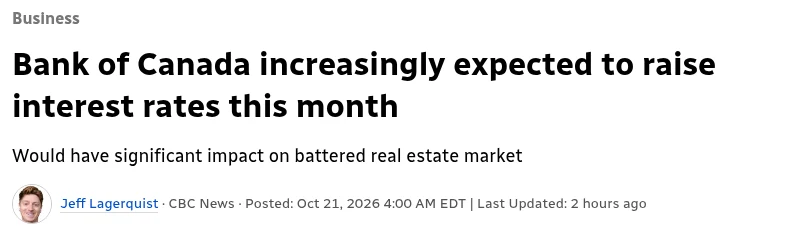
CBC reports that rate-hike expectations have strengthened, with some forecasts brought forward. It also notes that the consensus in a recent Bloomberg economist survey still pointed to a hold. Those statements are not necessarily contradictory: a survey taken earlier and market pricing observed later can diverge, and economists and traders are not the same group.
The lesson is not to treat any single percentage as certainty. It is to recognize that the risk borrowers need to manage has changed. A high market-implied probability is still not a Bank of Canada commitment.
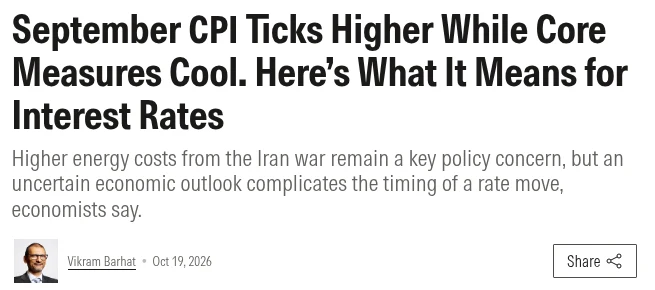
Morningstar’s October 19 analysis captures the dilemma: gasoline pushed headline inflation higher while important core measures softened. It presents both earlier-hike and hold arguments. Its reported market probabilities belong to October 19; they should not be substituted for CBC’s later October 21 snapshot or presented as today’s continuously updating odds.
Snapshots are included as limited headline excerpts for commentary and source identification. The linked publishers retain rights to their material. Their inclusion does not imply endorsement of this website or its mortgage services.
Why is the Bank of Canada facing pressure to raise rates?
1. Persistent energy inflation can become a broader problem
RBC Economics’ October 19 analysis reports September headline inflation of 3.1% year over year. It reports gasoline prices up 27.8% from a year earlier. Those figures describe inflation, not mortgage rates.
The policy concern is not simply that gasoline has become expensive. It is whether persistent energy costs spread into transportation, production, delivery and other prices, and whether businesses and consumers begin expecting higher inflation to last. An energy shock that initially looks temporary can become harder to look through if it repeatedly feeds other costs.
However, RBC also finds limited evidence of broad consumer-price spillover so far. It reports CPI excluding food and energy at 2.1% year over year, and relatively contained annual core measures. The concern is a future transmission risk, not proof that every category is already experiencing runaway inflation.
2. Firms are discussing cost pass-through, not just absorbing higher costs
The Bank of Canada’s third-quarter Business Outlook Survey, released October 19, says firms facing unusually large cost increases plan to keep passing them to customers. The report also says post-breakdown trade developments have increased inflation expectations and put upward pressure on costs and prices.
There is an important timing caveat: most main-survey interviews occurred before Canada-US trade talks broke down and new counter-tariffs were announced. The Bank distinguishes those interviews from later information. It would be misleading to describe every survey response as a fresh measurement of the same conditions on October 19.
For rate policy, the question is whether cost pressures are becoming embedded in pricing decisions. Interest rates cannot reopen a shipping route or remove a tariff, but policy can influence demand and the persistence of inflation pressures. The Bank must weigh that against the risk of weakening the economy further.
3. Trade uncertainty creates inflation and growth risks at the same time
Tariffs and supply-chain adjustments can raise business costs, while uncertainty can discourage investment, hiring and household spending. The Bank’s survey describes both forces. That is why “the economy is soft” does not automatically settle the rate decision in favour of a cut, and “inflation is above target” does not automatically establish that a hike is the best immediate response.
A rate increase could be considered to prevent inflation from becoming more persistent even in an uncomfortable economy. Equally, signs that inflation remains narrow and demand is weakening could support patience. This is a balancing decision, not a simple referendum on whether the economy is strong.
4. The Bank’s communication has sounded more urgent
CBC’s October 21 report and RBC’s October 19 analysis describe Governor Tiff Macklem’s increased concern about persistent energy costs and the risk that inflation broadens. RBC explicitly says recent communication increases the possibility of a pre-emptive move.
That explains why hike expectations can rise without a dramatic new core-inflation number. Policymakers are forward-looking. But stronger warnings still do not amount to a pre-announced October 28 rate increase.
Why are rate hikes being anticipated into 2027?
A tightening cycle would be about the persistence of inflation, not just one meeting. If the Bank concludes that the current policy setting is insufficient to contain second-round price pressures, a single quarter-point move might not be the end of the adjustment. That is a scenario behind several forecasts—not an official Bank of Canada rate path.
Scotiabank: a higher year-end policy rate in 2027
Scotiabank’s Forecast Snapshot, dated October 13, projects Canada’s policy rate at 2.50% at the end of 2026 and 3.25% at the end of 2027. Its table explicitly labels the future figures as forecasts and the policy-rate values as end-of-period.
Do not turn that table into a promise about every meeting. It does not, by itself, establish a specific October decision or a guaranteed sequence of increases during 2027. Nor is a projected overnight rate a projected mortgage quote.
Macquarie: a more substantial tightening scenario
CBC’s October 21 article reports that Macquarie economist David Doyle anticipates 125 basis points of policy-rate increases by the end of 2027. Starting from 2.25%, that would imply 3.50% if the forecast occurred in full. This is a conditional calculation of one named forecaster’s scenario—not a consensus or a guaranteed result.
RBC Economics: later tightening remained its published base case
RBC Economics’ October 19 note assumes no policy-rate change through the rest of 2026, followed by gradual increases in 2027, while acknowledging the increased risk of earlier action. CBC’s later reporting describes changes among other forecasts, including RBC Dominion Securities. These are different teams and publication dates; they should not be collapsed into a claim that every RBC forecast says the same thing.
The practical conclusion is that the date of the first increase remains contested, while several named forecasts point to an upward policy-rate risk extending beyond one announcement. A responsible mortgage plan should test that possibility without betting everything on it.
Why a hold on October 28 is still possible
The strongest reason not to call a hike “confirmed” is the evidence on the other side. TD Economics’ October 19 CPI commentary says underlying inflation remains relatively contained and supports its view that the Bank can stay on hold this year. It highlights downside risks from tariffs, a soft job market and higher bond yields.
Higher fixed borrowing costs can restrain spending even without a fresh overnight-rate increase. If energy pressures ease or fail to spread, the Bank may have more room to wait. If hiring weakens further, the cost of additional tightening also matters.
There are at least three reasonable planning scenarios:
- A hike on October 28: the Bank puts more weight on persistent inflation and spillover risks.
- A hold with a warning: the Bank leaves the rate unchanged but keeps future increases clearly on the table.
- A changed 2027 outlook: inflation, employment or trade conditions shift enough that the pace and direction of future policy differ from today’s forecasts.
None should be presented as a certainty. Forecasts are conditional judgments and can change quickly. This article is a dated assessment as of October 21, not a prediction dressed as an official announcement.
What would higher rates mean for Canadian mortgages?
The Financial Consumer Agency of Canada’s guide to mortgage interest distinguishes fixed-rate mortgages, fixed-payment variable mortgages and adjustable-payment variable mortgages. Their response to higher rates is not identical.
Adjustable-payment variable mortgages
If your contractual mortgage rate changes with lender prime, your payment will generally adjust under the lender’s rules. Confirm the effective date and actual payment amount rather than assuming that the Bank announcement and your payment change occur simultaneously.
Fixed-payment variable mortgages
A higher rate can send more of the same payment to interest and less to principal. The payment may initially stay unchanged, but that does not mean the higher rate has no cost. Trigger-rate or trigger-point provisions and any payment adjustments depend on the contract. Ask your lender how much room remains and what happens if rates increase further.
Existing fixed-rate mortgages
A Bank of Canada hike does not normally rewrite the rate on a fixed-rate mortgage during its existing term. The concern is the offer available at renewal, refinancing or a new purchase. Do not confuse “my current payment is fixed” with “my next mortgage will cost the same.”
New fixed-rate offers and renewals
Fixed mortgage rates can move before the policy announcement because bond markets and lender funding costs respond to expectations. They are not mechanically set by the Bank’s overnight rate. A hold on October 28 would not guarantee lower fixed offers, and a quarter-point policy hike would not guarantee a matching quarter-point increase in every fixed rate.
Read our guide to Canadian bond yields and fixed mortgage rates and see the live bond-yield and rate page for separately dated market data. This article intentionally does not present an October 21 lender quote as a rate available indefinitely.
What could this mean for Toronto and Ontario housing?
Higher borrowing costs can reduce purchasing power and make financing harder for some households. They can also affect the viability of development projects. But that does not produce a guaranteed house-price decline, a reliable buying opportunity or an identical effect across Toronto, York Region and every property type.
The safer distinction is between price and affordability. A lower asking price does not necessarily mean a lower monthly cost when financing, taxes, insurance, utilities and maintenance are included. Conversely, buying only because a forecast suggests prices will rise is not a substitute for a sustainable budget.
If you are comparing ownership with renting, use the rent-versus-buy tool to compare mortgage principal and interest, property-tax instalments, upkeep and other ownership costs against rent and monthly savings contributions. Evaluate the complete budget rather than a headline rate alone.
What borrowers should do before October 28
- Identify your actual exposure. Is your mortgage fixed, adjustable-payment variable or fixed-payment variable? Check the contract rather than relying on the product’s marketing label.
- Use more than one scenario. Compare holding, a quarter-point increase and a larger cumulative increase over time. These are stress tests, not forecasts that all increases will happen.
- Review real offers. Compare rate, term, penalties, prepayment rights, portability and any conversion option. A lower starting rate can still come with trade-offs.
- Ask about a rate hold. Confirm its expiry, conditions and whether a lower available rate can be considered later. A hold is not final lender approval.
- Keep cash reserves. Do not stretch the purchase or refinance budget on the assumption that lower rates will rescue it later.
- Prepare for renewal early. Gather your documents and compare choices before maturity. Do not make a long-term product decision from one expected announcement alone.
Use our mortgage calculator to test payment scenarios, or arrange a mortgage pre-approval review. For local help, see Toronto mortgage guidance. Calculations are planning aids; the lender must confirm pricing, qualification and contract terms.
My view: do not panic, and do not assume rates can only fall. The purpose of reviewing your mortgage now is to understand your choices before the next announcement—not to claim that a particular lender rate is held or that a rate increase is certain.
Frequently asked questions: October 28 and the 2027 rate outlook
Has the Bank of Canada confirmed a rate hike on October 28, 2026?
No. As of October 21, the October 28 decision has not been announced. CBC reports that markets increasingly anticipate a quarter-point hike, but expectations and economist forecasts are not a confirmed Bank of Canada decision.
What would a quarter-point Bank of Canada hike mean?
A 25-basis-point increase would move the overnight policy rate from 2.25% to 2.50%. That is not a mortgage rate quote. Changes to lender prime rates, loan rates and payments depend on the lender, product and contract.
Why are economists anticipating rate increases into 2027?
The concern is that persistent energy costs, tariffs and business cost pass-through could make inflation broader and more persistent. Scotiabank’s October 13 forecast projects a 3.25% Canadian policy rate at the end of 2027, but other forecasts differ and none is a guaranteed path.
Would every variable mortgage payment rise immediately?
Not necessarily. Adjustable-payment mortgages typically change payments when the contractual rate changes. Fixed-payment variable mortgages may instead direct more of the existing payment to interest, with trigger provisions depending on the contract. Confirm your lender’s terms and effective dates.
Can fixed mortgage rates rise before the Bank of Canada hikes?
Yes. Fixed mortgage pricing is influenced by bond yields, funding costs and lender pricing. Markets can price expected future inflation and policy changes before a Bank of Canada announcement. There is no guaranteed one-for-one move between the policy rate and fixed mortgage rates.
Should I lock my mortgage rate before October 28?
There is no single answer for every borrower. Compare actual offers, rate-hold conditions, renewal timing, penalties and payment resilience under several scenarios. A rate hold is not final approval, and neither a future hike nor a later rate drop is guaranteed.
Sources, article snapshots and fact-check notes
Checked October 21, 2026. Forecasts and market probabilities are attributed and dated; they are not official decisions. The Statistics Canada release was temporarily unavailable during verification, so inflation figures here are attributed to the separately checked RBC and TD analyses rather than represented as a direct extraction of that release.
- Bank of Canada: September 2 policy-rate announcement, September 2, 2026. Verified from the original release HTML: 2.25% hold and October 28 decision/MPR date.
- Jeff Lagerquist, CBC News: Bank of Canada increasingly expected to raise interest rates this month, October 21, 2026. Dated 87% market-pricing estimate, forecast revisions and Macquarie’s 2027 scenario. Headline snapshot captured October 21.
- Vikram Barhat, Morningstar: September CPI Ticks Higher While Core Measures Cool, October 19, 2026. Competing economist views and dated inflation context. Headline snapshot captured October 21.
- Abbey Xu, RBC Economics: Canadian inflation ticked higher in September, October 19, 2026. CPI details, spillover assessment and that team’s published policy-rate base case.
- Leslie Preston, TD Economics: Canadian Consumer Price Index, September 2026, October 19, 2026. Underlying inflation and the case for holding in 2026.
- Scotiabank Economics: Forecast Snapshot, forecasts dated October 13, 2026; accessed October 21. End-of-year policy-rate forecasts, not a meeting-by-meeting schedule.
- Bank of Canada: Business Outlook Survey, Third Quarter of 2026, October 19, 2026. Pricing intentions, trade uncertainty and survey-timing limitations.
- Financial Consumer Agency of Canada: Interest on mortgages, modified February 23, 2024; accessed October 21, 2026. Fixed, variable-payment and fixed-payment mortgage mechanics.
General information only, not individualized financial, legal or investment advice. Future decisions, inflation, bond yields and mortgage rates can differ materially from forecasts. Confirm your lender’s current terms before acting.